Bleeding a radiator is a simple six-step job: turn off the heating, let the system cool, locate the bleed valve, release the trapped air with a radiator key, close the valve once water appears, then top up your boiler pressure.
It's the fastest way to fix a radiator that stays cold at the top while the bottom heats up normally, and it takes most homeowners under ten minutes with no tools beyond a radiator key and a cloth. Doing it now, before the weather turns, means your heating won't let you down on the first cold night of the year.
What Does Bleeding a Radiator Do for Your System?
If a radiator is warm at the bottom but stone cold at the top, air has become trapped inside the panel. Bleeding it releases that trapped air pocket, letting hot water fill the whole panel again. It also protects your bills: when air blocks circulation, the boiler has to work harder to heat the same room, which shows up as higher gas usage on your meter.
Step-by-Step Guide to Bleeding a Radiator
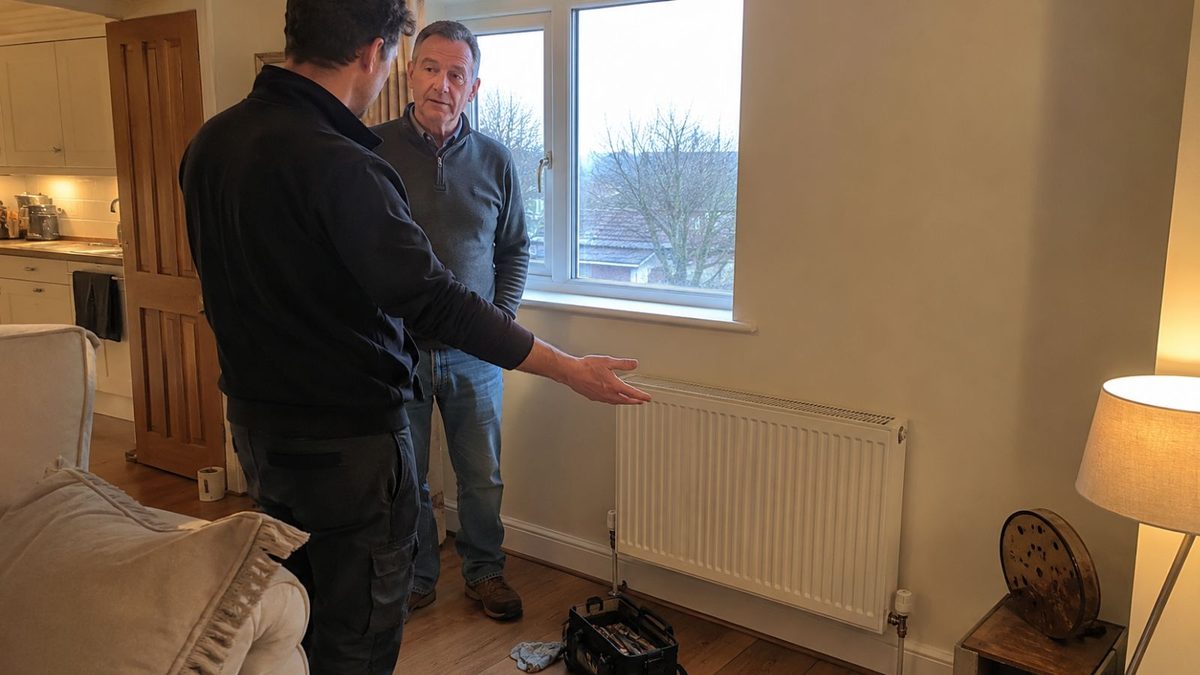
You'll need a brass radiator key and a dry cloth to catch any drips of dark system water. If bleeding doesn't fix a stubborn cold spot, it's worth reading our guide on Why Your Radiator Isn't Heating Up to rule out a stuck valve or sludge build-up.
- Turn off the central heating completely. Running the pump while you bleed a radiator can draw more air into the system.
- Wait at least 30 minutes for the system to cool. This stops boiling water or steam from scalding your hands.
- Locate the small square bleed valve at the top corner of the radiator and insert your key into the centre slot.
- Hold your cloth underneath the valve to catch any drips and protect your flooring or skirting boards.
- Turn the key slowly counter-clockwise, typically a quarter to half turn, until you hear air hissing out.
- Close the valve firmly the moment the hissing stops and the first drop of water appears.
Handling Bathrooms: Bleeding a Towel Radiator
Bathroom towel rails follow the same principle but need a slightly different approach. Because they're tall and narrow, trapped air collects at the very top bar, and the bleed valve is often hidden behind a small chrome cap or tucked under the top bracket.
Water tends to spray out faster from a vertical rail than a standard horizontal radiator, so keep your cloth draped fully over the key as you turn it to stop any spray reaching the tiles.
The Critical Final Step: Checking Boiler Pressure
⚠️ Releasing air from your radiators reduces the overall water volume in the system, so your boiler pressure will drop. Once you've finished bleeding, check the pressure gauge on your boiler. If the needle has fallen below 1 bar, use the filling loop to top the system back up until it reads between 1.0 and 1.2 bar.
When to Call a Professional Heating Engineer
If a radiator stays cold at the bottom even after bleeding, or you notice a heavy cold patch in the centre of the panel, that's iron oxide sludge rather than trapped air. Sludge needs a professional central heating flush to clear the rust deposits and restore proper flow.
As a trusted local plumber, R.W. Miller provides transparent diagnostics and system overhauls across South London, including Wandsworth, Bromley, Lambeth, and Greenwich. All work is carried out personally by Reion Miller, a fully qualified engineer on the Gas Safe Register (Reg. No. 919881). If your system is making strange bubbling noises or radiators are heating unevenly even after venting, it's worth getting a proper diagnostic rather than repeatedly bleeding the same panel.
Book a Central Heating Check with R.W. Miller
Our rates are straightforward: a fixed £80 diagnostic and balancing assessment for the first hour, then a clear £90/hr after that. If bleeding hasn't solved the problem, call Reion directly on 07375 813996 or book a fixed-price appointment to get your central heating service sorted before winter.