While low boiler pressure typically causes your heating to shut down, boiler pressure too high is a different type of issue. It puts unnecessary stress on your central heating pipework, radiator valves, and the delicate hydraulic seals inside your appliance.
If your pressure gauge is creeping into the upper red zone, it is a clear sign that the system is overfilled or an internal component is failing. Some causes you can check yourself in under ten minutes — others need a Gas Safe engineer before they become expensive.
What Should Your Boiler Pressure Actually Read?
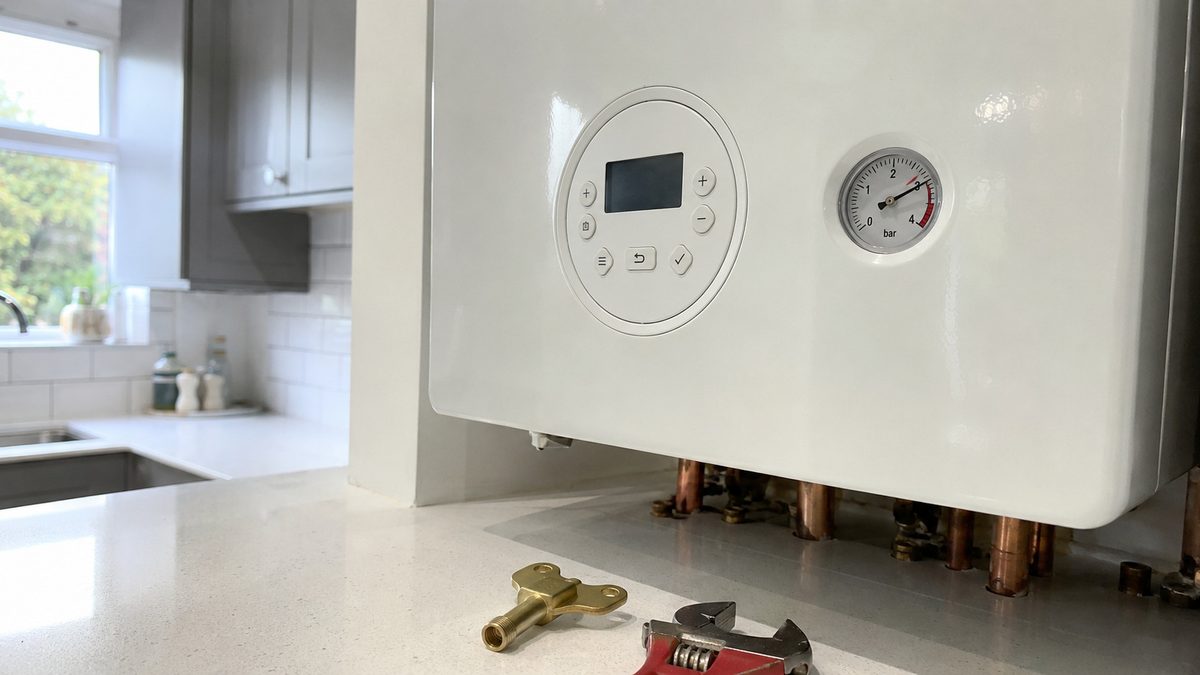
Before adjusting your system, check the gauge on the front panel of your boiler when the heating is completely cold.
- Ideal Cold Pressure: The needle should rest between 1.0 bar and 1.2 bar. This baseline gives the water adequate room to expand safely as it heats up.
- Normal Hot Pressure: When the heating is running hard, the water expands, and the needle will naturally rise to between 1.5 bar and 2.0 bar.
- High Pressure Warning: If the needle passes 2.5 bar or enters the solid red zone (typically 3 bar), your system is over-pressurised and needs attention.
Why Is Your Boiler Pressure Too High?
High pressure almost always points to one of three common issues:
1. The System Was Recently Overfilled: If you recently topped up a low system using the filling loop hose, you may have left the valves open for a moment too long or failed to shut them completely. This continuously forces fresh mains water into your sealed circuit.
2. Trapped Air in the Radiators: Air pockets sitting inside your radiators expand significantly as they get hot, artificially pushing the overall water pressure up past safe limits.
3. A Faulty Expansion Vessel or Valve: Inside your combi boiler, a small pressurised tank called an expansion vessel manages the changing water volume. If this tank fails or becomes waterlogged, the pressure will spike rapidly every single time the heating fires up. This is not a DIY fix — it requires a Gas Safe engineer to diagnose and replace safely.
Not sure which one applies to your system? Reion can isolate the exact cause in a single visit — book a diagnostic.
What to Do: Quick Checks Before You Call
If your boiler pressure is reading above 2.5 bar, run through these two checks first. They take under ten minutes and may bring it down — but if the needle climbs back up within a day or two, stop here and call a professional.
Step 1: Check the Filling Loop Levers
Look underneath your boiler and locate the flexible silver hose or built-in plastic levers. Ensure both tap handles are turned completely perpendicular to the pipework. If a valve is left even slightly cracked open, it will constantly feed mains water into the system, driving the gauge up.
Step 2: Bleed a Radiator to Release Pressure
Bleeding a radiator is the quickest way to manually lower boiler pressure that is reading too high.
- Switch off the central heating and let the water cool down for 30 minutes.
- Locate the small bleed valve at the top corner of any radiator panel.
- Insert your radiator key and place a cloth and small container directly underneath to protect your flooring.
- Turn the key counter-clockwise slowly. Let any trapped air hiss out, followed by a steady stream of water.
- Watch the main boiler gauge. Keep draining water until the needle drops safely back down into the ideal 1.0 to 1.2 bar zone, and then lock the valve tightly.
The Automatic Safety Pipe: If your system hits a critical 3 bar, a mechanical safety device called the Pressure Relief Valve (PRV) will trigger automatically. You will notice water actively dripping or blowing out of a small copper pipe on your external wall. This is a normal emergency safety response designed to prevent internal seals from blowing.
When to Call a Gas Safe Engineer
If you bleed a radiator to bring the low boiler pressure to 1.5 bar, but the needle creeps right back up into the red zone within a few days, you cannot fix this yourself. A boiler pressure that keeps rising points to a failed filling valve or a waterlogged expansion vessel — neither of which can be safely resolved without a qualified engineer.
Continuing to run an over-pressurised system is not just inconvenient. A blown internal seal or a hidden leak developing behind a wall or inside the boiler casing can cost significantly more to put right than a same-day diagnostic visit.
R.W. Miller provides honest, transparent technical diagnostics and emergency support across South London, including Wandsworth, Bromley, Lambeth, and Greenwich. All gas and heating work is carried out by Reion Miller, a fully qualified, independent professional registered with the Gas Safe Register (Reg. No. 919881).
Our straightforward trade rates are completely transparent: we charge a fixed £80 diagnostic fee for the first hour to isolate the exact cause of the pressure spike, with a clear £90 per hour rate thereafter if extra diagnostic or component work is required. You will receive an explicit, fixed-price quote before any major parts are replaced.
If your boiler pressure keeps going up or your external pipe is constantly dripping, call Reion directly on 07375 813996 or make an appointment for an independent, professional assessment.