If you let a property in the UK, you are legally required to hold a current gas safety certificate for every gas appliance in that property. This is not optional and not discretionary — it is a legal obligation under the Gas Safety (Installation and Use) Regulations 1998. Here is everything landlords need to know about what the certificate covers, how often it must be renewed, and what happens if appliances fail.
What is a gas safety certificate?
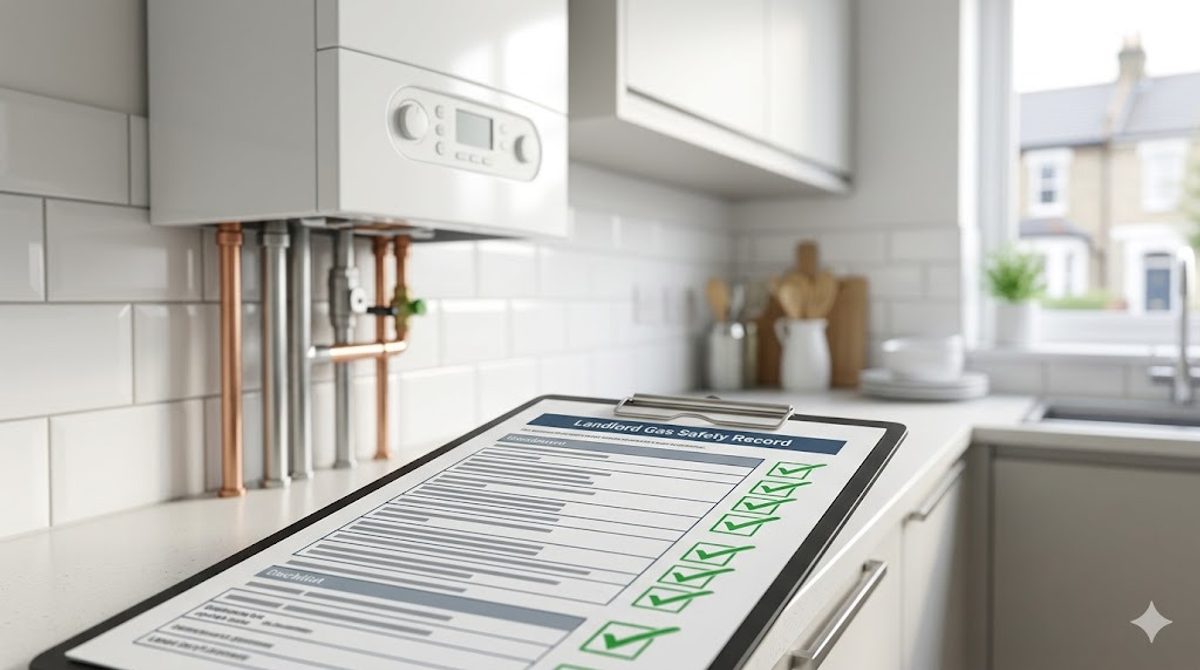
A gas safety certificate — formally called a Landlord Gas Safety Record or CP12 — is a document issued by a Gas Safe registered engineer after inspecting all gas appliances, fittings, and flues in a rental property. It confirms that all gas installations are safe and operating correctly as of the date of inspection.
The CP12 number refers to the CORGI (now Gas Safe) proforma used for the record. The document lists every appliance inspected, the results of each check, and whether each appliance passed or failed. A certificate issued after a property passes inspection is valid for 12 months.
Who must have a gas safety certificate?
Any landlord letting residential accommodation with gas appliances is required by law to hold a current certificate. This includes:
- Private landlords renting to individual tenants
- Houses in multiple occupation (HMOs)
- Housing associations and social landlords
- Landlords renting furnished or unfurnished properties
Homeowners are not legally required to have a gas safety certificate, but many choose to obtain one — particularly before selling. The certificate is a legal obligation only when gas appliances are present in rented accommodation.
How often must the certificate be renewed?
Every 12 months. The certificate expires one year from the date of issue. Landlords should arrange the inspection before the certificate expires — do not wait until the expiry date, as engineer availability may cause delays.
There is a useful rule for early renewals: if you renew in the last two months of the current certificate's validity, the new certificate runs 12 months from the expiry date of the existing certificate — not from the new inspection date. This means you do not lose any coverage by renewing a few weeks early.
What does the gas safety inspection cover?
A Gas Safe engineer will inspect every gas appliance in the property. This typically includes the boiler, any gas fires or room heaters, gas hobs, and gas ovens. For each appliance the engineer checks:
- Gas pressure and flow rate
- Combustion safety — confirming clean burning with no dangerous emissions
- Flue integrity and draw — ensuring combustion gases are being safely expelled
- Flame failure devices and safety cut-offs
- Ventilation for combustion air
- Gas pipework and flexible connectors for leaks or deterioration
The inspection typically takes 30–60 minutes for a standard property. An HMO or property with multiple gas appliances will take longer.
What happens if an appliance fails?
If a gas appliance is found to be dangerous — an unsafe flue, an appliance producing carbon monoxide, a significant gas leak — the engineer is required to make it safe. This usually means disconnecting the appliance and issuing an 'Immediately Dangerous' (ID) notice. The appliance must not be used until the fault is repaired by a qualified engineer.
If an appliance is potentially dangerous but not immediately so — a minor flue issue that needs monitoring, an appliance that is at the end of its service life — the engineer issues an 'At Risk' notice. The appliance can remain in service but the landlord is required to arrange repair or replacement.
A certificate cannot be issued for a property where an appliance has failed and not been repaired. The remedial work must be completed and the appliance re-inspected before the CP12 can be issued.
What are the penalties for not having a gas safety certificate?
Landlords who fail to obtain a gas safety certificate, or who fail to provide it to tenants, can face a fine of up to £20,000 and/or imprisonment if prosecuted in a Magistrates' Court. In more serious cases — particularly where a tenant is injured or killed as a result of a gas incident — the case can be referred to the Crown Court, where the fine is unlimited and imprisonment is also possible.
The certificate must be provided to existing tenants within 28 days of the inspection, and to new tenants before or on the day they move in. Failure to provide the certificate to tenants is itself a separate breach.
Booking a gas safety certificate in South London
R.W. Miller provides CP12 gas safety certificates for landlords and letting agents across South London — Southwark, Lambeth, Wandsworth, Lewisham, Greenwich, Bromley, and the Surrey (KT and SM) postcodes. Certificates are issued on the day of inspection. Call 07375 813996 to book — appointments are typically available within 48 hours.