A drop in boiler pressure is the most common cause of central heating failure — and one of the few faults you can sort yourself in under five minutes. The process is straightforward once you know where the filling loop is. What it won't fix, though, is a boiler where the pressure keeps coming back down. If you're topping up repeatedly, there's a leak, and topping up is only making it worse.
Finding your filling loop
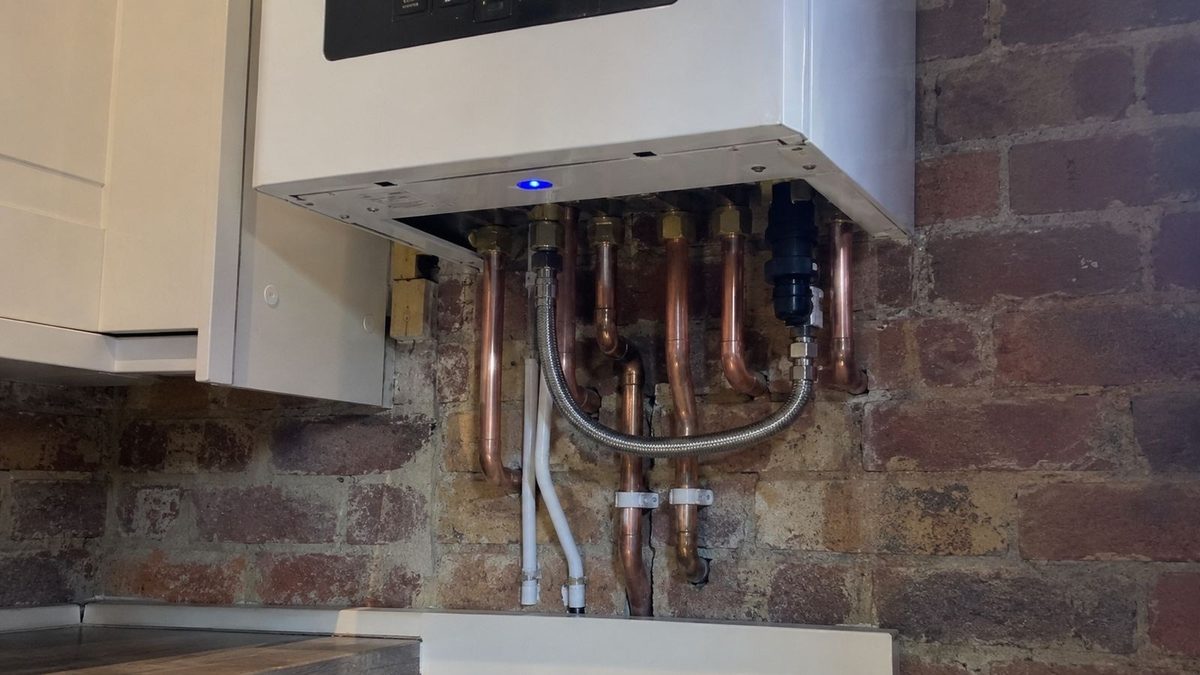
Before you do anything, you need to find the filling loop — the connection between your mains water supply and the central heating circuit. It comes in three main forms:
- External braided hose: a short, flexible silver hose underneath or beside the boiler, with a valve at one or both ends. You may find it disconnected — it's supposed to be.
- Internal keyed link: common on older Worcester Bosch boilers. A white plastic key slots into the underside of the casing and connects the loop when turned.
- Internal keyless lever: on most modern boilers, a blue or white lever built into the bottom of the casing that you pull down.
If you can't find it, don't start pulling at random pipework under the boiler. Gas lines run in the same area. If you're not sure what you're looking at, call an engineer.
How to repressurise your boiler
- Switch off the boiler at the electrical switch or fused spur. Let the system cool for at least 30 minutes — adding cold mains water to a hot heat exchanger can crack it, which is an expensive repair.
- If you have an external braided hose and it's disconnected at one end, screw the loose end firmly onto the second valve fitting. Hand-tight is enough.
- Open the filling valves. If there are two, open the first fully, then ease the second one open slowly. You'll hear water moving into the system.
- Watch the pressure gauge. Aim for 1.5 bar rather than 1.2 — the pressure rises naturally when the system heats up, so starting a little higher means it stays in the correct range. Close both valves as soon as you hit 1.5 bar.
- Disconnect the external hose if you have one. UK water regulations require it to be physically removed when not in use — it's there to stop heating water backflowing into your drinking supply.
- Switch the boiler back on and run the heating for ten minutes. Check that the pressure holds and doesn't climb above 2.5 bar.
What if I over-pressurise it?
If you went a little over and the needle is sitting above 2.5 bar, don't panic. Most modern boilers have a pressure relief valve that kicks in at 3 bar — you'll notice water dripping from a small copper pipe outside the property if it activates.
To bring the pressure down manually, bleed a radiator with a radiator key. Catch the water in a cloth or small container and keep going until the gauge drops back to 1.2–1.5 bar. Then close the radiator bleed valve and you're done.
Why does the pressure keep dropping?
A sealed central heating system shouldn't lose water. If you're topping up more than twice a year, something is leaking. Common places to check:
- Radiator valves — look for rust-coloured staining around the base of the valve fittings
- The pressure relief valve — if it's been activating, water will be dripping from the overflow pipe outside
- The expansion vessel inside the boiler — if it's waterlogged, pressure will spike when the system heats up and bleed off each time
- A pinhole leak in a pipe run — shows up as damp patches on walls, ceilings, or floors
The reason this matters: every time you add fresh mains water to the system, you're introducing oxygen. Oxygenated water corrodes radiators, pipework, and the boiler heat exchanger from the inside. Topping up regularly isn't just inconvenient — it's gradually damaging the system.
When to call an engineer
Topping up once or twice a year is normal. Call a Gas Safe engineer if:
- The pressure drops more than twice in a single month
- You can see water weeping from a radiator valve, pipe joint, or boiler component
- The pressure drops immediately after you repressurise — that points to a significant active leak
- You can't locate the filling loop and aren't confident about what you're looking at
R.W. Miller covers boiler pressure faults and boiler repair across South London — including Wandsworth, Bromley, and Greenwich. The £80 diagnostic fee covers a full assessment of the system and a fixed-price quote before any work starts. Call Reion on 07375 813996.