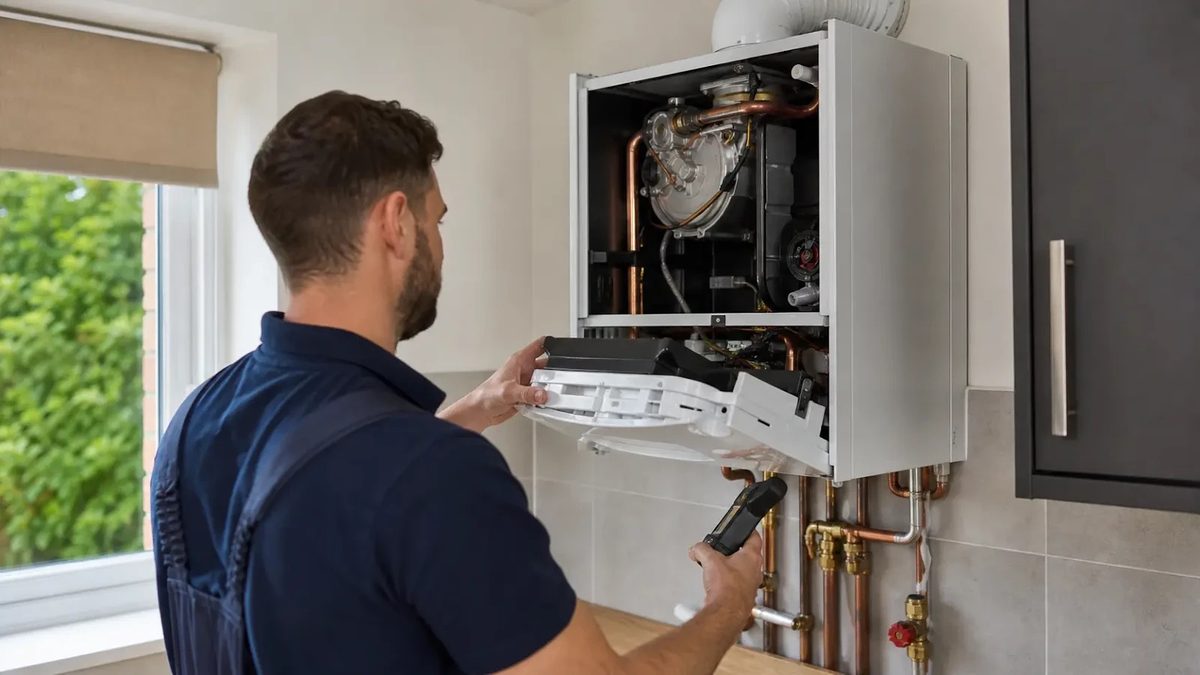
A boiler service includes a visual check of the boiler and flue, an inspection and clean of the burner, heat exchanger and condensate trap, a combustion test with a flue gas analyser, testing of the safety devices, a system pressure check and a written service record. On most combi boilers it takes 45 minutes to an hour.
A boiler service is a yearly inspection, clean and safety test carried out by a Gas Safe registered engineer to the manufacturer's instructions. This guide explains what happens during a boiler service, so you can tell a proper annual boiler service from a quick look round. It is written by Reion Miller, a Gas Safe registered engineer (919881) working across South London and Surrey.
Boiler service checklist: the 10 checks
The exact procedure varies by manufacturer, but every full gas boiler service should cover these checks.
- Visual inspection. The casing, the gas and water connections, and the pipework are checked for leaks, corrosion and scorch marks.
- Flue. The terminal outside and the visible joints are checked for damage, and to make sure nothing has been built or grown too close to the outlet.
- Combustion chamber seals. The casing comes off and the seals are checked, because a perished seal can let flue gases escape inside the case.
- Burner and heat exchanger. Both are checked for debris, corrosion and cracks, and cleaned when needed. The heat exchanger is one of the most expensive parts in the boiler.
- Electrodes and fan. Worn or carboned electrodes are a common reason a boiler fails to light.
- Combustion analysis. A calibrated analyser measures CO and CO2 in the flue to confirm the boiler is burning gas within the manufacturer's limits. If your engineer did not use an analyser, you have not had a full service.
- Gas pressure. The gas pressure is checked at the boiler, plus the gas rate where the manufacturer requires it.
- Safety devices. The overheat thermostat, flame failure system and pressure relief valve are tested. A relief valve letting by often shows up as a dripping pipe on the outside wall.
- Condensate trap. The trap is removed, cleaned and refilled. A blocked trap stops the boiler working, and an unlagged external pipe is the usual cause of a frozen condensate pipe.
- System pressure, final run and service record. The engineer checks the pressure and the magnetic filter, runs heating and hot water, and gives you a written record of the work and the combustion readings.
Keep the service record with your boiler manual. Manufacturers ask for it when you make a warranty claim.